Notice: Trying to access array offset on value of type bool in /home/petropet/public_html/imfmag.com/wp-content/themes/likeawiki/inc/theme-options.php on line 165

How America lives today

Everyday life in the United States is practically no different from life in other countries. People solve similar problems, only at a different financial, cultural and technological level.


America is America

High taxes

In return, we get government protection.

Decent pension

Of course, this only applies to decent taxpayers.

Care for retirees

Old people can always count on the services of a caregiver.

Health care

For doctors, there is no such thing as age.

photo-1610022069496-955617dd718c

to work in the morning

The average person gets up to work in the morning, takes a shower, eats, many here go to the gym before work, then go to work, work, who is at a construction site, who is in the computer industry, who is in the office.

photo-1593088626237-367da22d97c2

Honesty & fairness

In restaurants, hotels or other similar establishments, customers are never cheated. If this happens, then the injured party is obliged to reimburse the losses and apologize, and the employee who made such a mistake is kicked out or punished with large fines. Check surcharges exist in the United States only in a few Russian restaurants, where they practice such a scheme as to tip the total price.

USA today

Free medicine

Even if a person does not have health insurance and does not have money for treatment, then in the United States he will not be left to fend for himself, but in any case they will provide the necessary medical assistance.

They will be sent later by mail, but the person is guaranteed to get rid of health problems. Cigarettes are very expensive. If it becomes known that the seller has provided cigarettes to minors, then his license will be revoked.

Iron on a Nutrition Label: Serving Size and Daily Value

A breakfast cereal can display a large iron percentage while a different food shows a smaller number beside a much smaller serving. Comparing those percentages without reading the serving information can produce a misleading shopping decision. The label describes a defined quantity of food, not the entire package by default.

Iron is a useful example for learning how the Nutrition Facts panel works because milligrams, serving size and percent Daily Value answer related but distinct questions. Once those pieces are separated, the label becomes easier to use without treating it as a personal blood test or a prescription.

Find the serving before the nutrient

Start with the stated serving size and servings per container. The nutrient amounts usually refer to that serving, unless the panel explicitly provides another basis. A package can contain more than one serving even when it is convenient to eat it at once.

The FDA’s guide to the Nutrition Facts label explains the relationship between serving information, nutrient amounts and percent Daily Value. Serving size reflects the label’s reference amount; it is not an instruction that every person should eat exactly that quantity.

For a fictional cereal, suppose the serving is thirty grams. If your bowl contains forty-five grams, it contains one and a half labelled servings. The amount eaten, rather than the size of the bowl or the photograph on the box, determines the multiplier.

Distinguish milligrams from percent Daily Value

Milligrams express an amount of iron. Percent Daily Value expresses that amount relative to the reference value used for the label. The two are connected by arithmetic, but the percentage is not a direct statement of how much of your personal requirement has been absorbed.

The NIH Office of Dietary Supplements’ iron fact sheet identifies the US iron Daily Value as eighteen milligrams for adults and children aged four years and older. Individual dietary requirements differ by circumstances, so the label reference should not be treated as a personalized target.

Using that reference, a hypothetical serving containing 3.6 milligrams corresponds to twenty percent of the Daily Value: 3.6 divided by 18, multiplied by 100. This calculation explains the label; it does not specify a supplement amount or interpret anyone’s iron status.

Scale the amount to the portion

If the fictional cereal contains 3.6 milligrams per thirty-gram serving, a forty-five-gram portion contains 5.4 milligrams before considering label rounding. The serving multiplier is 45 divided by 30, or 1.5. Multiply the listed amount by 1.5.

The corresponding unrounded percentage would be thirty percent. If you add milk, fruit or another food, those ingredients contribute their own nutrient amounts; they are not automatically included in the cereal’s dry-product panel. Check whether the label supplies an additional prepared-food column.

Keep the calculation’s basis visible. “5.4 milligrams in this hypothetical portion” is clearer than “the cereal contains 5.4 milligrams,” which could be misread as a per-serving or per-package amount. A small note about portion size prevents the number from losing its meaning.

The same method works for a smaller portion. Fifteen grams is half of the fictional thirty-gram serving, giving 1.8 milligrams and an unrounded ten percent Daily Value. Writing both examples beside the label makes the proportional relationship clear without assuming that the household always uses the printed serving size.
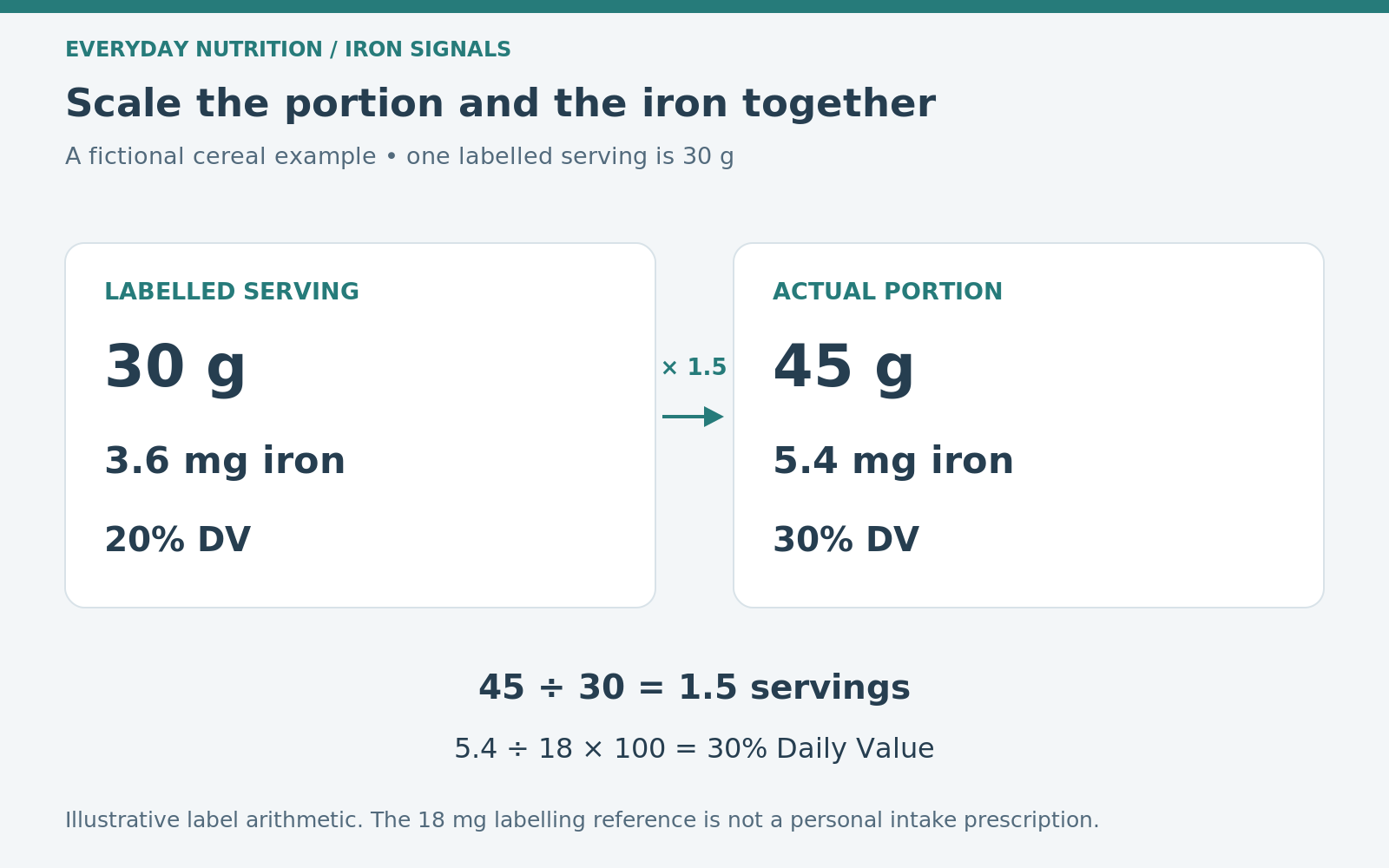
Two panels compare a 30 gram serving containing 3.6 milligrams iron and 20 percent Daily Value with a 45 gram portion containing 5.4 milligrams and 30 percent Daily Value.
The example scales both food weight and iron amount by 1.5. The Daily Value remains 18 mg; this is label arithmetic rather than a personalised intake target. Image credits.

Compare foods on a useful basis

Suppose food A provides 3.6 milligrams per thirty grams and food B provides 2.7 milligrams per fifteen grams. Food A has more iron per labelled serving, but food B has more per gram. Which comparison is useful depends on how much of each food you expect to eat.

For equal thirty-gram amounts, the fictional food B would provide 5.4 milligrams. That does not make it automatically the better overall choice. The comparison concerns one nutrient under a specified portion assumption; other nutritional and practical considerations remain separate.

A shopping note can use three columns: portion considered, iron amount and other relevant food characteristics. This avoids ranking entire diets by one prominently displayed percentage. It also makes clear whether a comparison uses equal weights or ordinary eating portions.

Do not confuse intake with absorption

The iron amount in food is not identical to the amount that ultimately enters circulation. Food composition, iron form and the body’s regulation of absorption affect the relationship. A Nutrition Facts panel does not measure that process in the individual reader.

For that reason, adding percentages from several labels gives a label-based intake estimate, not a direct readout of iron stores. The arithmetic can be useful while still answering only the intake question. Blood measurements and physiological regulation belong to a different part of the story.

This is also why a high percentage should not be interpreted as a guarantee of more energy or better exercise performance. A nutrient amount describes the food. A claimed change in how a person feels or functions requires additional evidence and context.

Allow for rounding and preparation

Labels may present rounded amounts and percentages. Recalculating one rounded number from another can therefore produce a small discrepancy. Avoid reporting more decimal places than the original information can support.

Preparation can change the amount represented by a portion. A dry product, a cooked product and a product prepared with specified ingredients may use different serving descriptions. Read the basis before comparing a dry-food label with a database entry for a prepared dish.

In a household spreadsheet, retain the exact label wording alongside the number. A column stating “dry product” or “as prepared with listed ingredients” can be more valuable than an extra decimal place. It identifies what was actually counted.

Record the product version as well. A reformulated cereal can keep a familiar name while changing its label. Retaining a photograph or transcription of the panel makes an older food record understandable when the package later changes.

Use the label for the question it can answer

A clear label-reading sequence is to identify the serving, record the iron amount, understand the reference percentage and scale to the planned portion. Then keep the resulting intake estimate separate from questions about storage, transport or absorption.

Those later questions lead to proteins such as ferritin and transferrin and to the peptide hormone hepcidin. The label remains the starting record of food composition, while the body’s iron system determines what happens after eating. Understanding the difference gives everyday nutrition numbers a more accurate and useful place in the larger picture.

Anavar in the History of the USA – From Medical Marvel to Performance Controversy

In the annals of American history, certain advancements have left an indelible mark on society’s fabric. Anavar for sale, a synthetic anabolic steroid, stands as a testament to the complex relationship between medical innovation, performance enhancement, and ethical concerns. This blog post delves into the history of Anavar in the United States, tracing its journey from the best steroids for bulking to a subject of controversy.

The Medical Marvel Emerges

Anavar for sale, scientifically known as oxandrolone, was first developed in the 1960s by Raphael Pappo and Christopher J. Jung at Searle Laboratories (now Pfizer Inc.). Initially intended to treat various medical conditions, Anavar gained prominence for its remarkable anabolic properties and relatively mild androgenic effects. It was hailed as a groundbreaking treatment for muscle-wasting diseases, severe burns, and post-surgical recovery, offering patients a chance to regain lost muscle mass and strength.

Anavar’s Medical Applications

  1. Muscle-Wasting Diseases: Anavar’s ability to promote muscle growth made it an effective treatment for conditions such as HIV/AIDS-related wasting and Turner syndrome, a genetic disorder that leads to stunted growth and delayed puberty.
  2. Burns and Trauma: Anavar’s ability to aid in protein synthesis and nitrogen retention proved invaluable in helping burn victims recover faster and mitigate muscle loss during the healing process.
  3. Weight Gain in Underweight Patients: Anavar was used to counteract weight loss in patients suffering from chronic illnesses, allowing them to regain body mass and improve overall health.

The Performance Enhancement Dilemma

As Anavar’s medical applications gained recognition, so too did its potential for enhancing athletic performance. Bodybuilders and athletes started using Anavar to augment their muscle growth, increase strength, and improve physical endurance. The drug’s mild androgenic effects were appealing to many, as they were associated with fewer unwanted side effects compared to other anabolic steroids.

Anavar and Sports

The use of substances like Anavar for sale, along with testosterone cypionate, has sparked debates over ethics and fairness in sports. Athletes looking for an edge in their performance often turn to various anabolic steroids. While Anavar remains a popular choice, others may seek out Masteron for sale, which is also known for its muscle-enhancing properties, though it comes with its own set of ethical and health considerations. These substances continue to fuel discussions around doping regulations, fair play, and the integrity of sports.

Regulation and Restrictions

As concerns over performance-enhancing drug use grew, regulatory bodies such as the World Anti-Doping Agency (WADA) and the U.S. Anti-Doping Agency (USADA) imposed strict regulations on the use of Anavar and similar substances in sports. Anabolic steroids were classified as controlled substances, requiring prescriptions for medical use. These regulations aimed to curb the misuse of Anavar while preserving its legitimate medical applications.

Conclusion

The history of Anavar in the United States exemplifies the intricate interplay between medical progress, human ambition, and ethical dilemmas. From its origins as a medical marvel that offered hope to patients with muscle-wasting conditions to its subsequent role in the realm of sports and performance enhancement, Anavar’s story is one of complexity and controversy.

While Anavar’s medical benefits cannot be denied, its transition from a therapeutic tool to a performance enhancer highlights the need for ethical considerations and regulations to ensure a fair and safe competitive environment. As the discourse surrounding the use of performance-enhancing substances continues, the legacy of Anavar serves as a reminder of the fine line between medical advancement and the potential for misuse in pursuit of success.

Top 7 supplements for explosive speed

Athletes are like the country’s gems; they create the country’s image in various nations. They must play the game with good speed and efficiency to achieve their goals. To achieve their goals, a person can either include the good food items in the diet or just do the exercise regularly.

If the person includes these food items in the diet, they can have better production of the testosterone hormone. This is the main male sex hormone that is not only responsible for their overall growth but also increases efficiency. Therefore, as per the research, they will sharpen the mass of muscles and memory. You can use exogenous form of testosterone if you have a deficiency of its natural levels: buy anavar online to get an injectable form of test hormone just to your doors. For those exploring stronger compounds, tren where to buy is a common search — just be sure to prioritize quality and safety if considering such options.

Some of the food items that increase the efficiency of the person to play ten-game are as follows:

  1. Beetroot Juice

Beetroot juices are the best option for athletes, as it increases the blood flow that boosts the person’s energy level. A person should always have a good amount of juice regularly as it will always reduce the deficiency of the blood in the person.

  1. Vitamin D

Vitamin D is considered the vitamin that is crucial for all athletes. Its deficiency might result in weakness and pain in the legs. Vitamin D will ultimately affect the capability of the person to play the game. Sun is one of the best sources of vitamin D. even supplements are available on the market to reduce its deficiency.

  1. Coffee

Consumption of coffee proves to be a good option for athletes. It contains caffeine that will lead to an increase in the strength of the person. If the person consumes coffee an adequate amount, then there will be an improvement in the brain’s functioning.

  1. Protein Powder

Especially in the case of vegetarians, protein powder consumption is recommended. Normally, it is not possible for them to fulfill the diet requirement in their normal diet. Therefore, a person should go for the protein as it fulfills the requirement of the person.

  1. Iron

Iron is another essential vitamin that the body of the person requires. If the person faces a lack of iron, then it causes the occurrence of anemia. It can be the root cause of the increment in the chance of the injury. This will have a sure impact on the game of the person. Even the transport of the oxygen is affected. Spinach is the best source of iron.

  1. Sodium Bicarbonate

Sodium bicarbonate is also called baking soda by some people. It is the option that helps reduce the hydrogen ions from the body. As a result, the person will not face fatigue; he can do the exercise energetically.

  1. Gelatin

Even in the current period, people believe that a person should add a good amount of gelatin to the diet. Gelatin is the ingredient that will help in the repairing of the joints. Injuries and joint pain is the common problem that most athletes face. In this situation, the consumption of gelatin is the best option.

If the athlete adds the things mentioned above to their diet, it will lead to an increment in their efficiency.

Few days off

There are very few holidays in the work calendar – only about 5-6 a year.

Secondary education is compulsory and lasts 12 years. If children skip school, parents should expect a visit from social workers.